YouTube Content Optimisation Case Study: Turning a Video Library into a Searchable Course-Discovery Series
Helping Bristol Adult Learning turn finished videos into discoverable, connected YouTube content
Producing a good video is only part of the job. Once an organisation has a collection of finished video assets, a second question becomes important:
How will people find them, understand what each video offers, and move from watching a video to taking the next step?
For Bristol Adult Learning, Xelium created a complete collection of video content from an interview with philosophy tutor Leo at Stoke Lodge in Bristol. The finished package included:
- 1 full-length edited interview
- 9 standalone topic videos
- 14 vertical key-moment videos for social media
The next stage was to make that content work effectively on YouTube. The original project scope included preparation of suitable YouTube titles, descriptions, keywords, categories, chapter breakdowns and captions for uploaded videos.
Rather than treating YouTube simply as somewhere to store finished video files, we structured the content as a searchable and connected video series designed to support course discovery.
A Strong Video Library Still Needs Structure
By the end of the editing process, Bristol Adult Learning had a substantial collection of philosophy content. That created an opportunity, but also a new challenge. Without careful organisation, the videos could easily have become:
- a collection of unrelated uploads;
- titles that made sense internally but not to prospective learners;
- descriptions that repeated the same information;
- videos without clear links back to course information;
- long-form content that was difficult to navigate;
- short-form content disconnected from the wider series.
The objective was therefore not simply to upload the videos. It was to give every asset a clear role within a wider YouTube content journey.
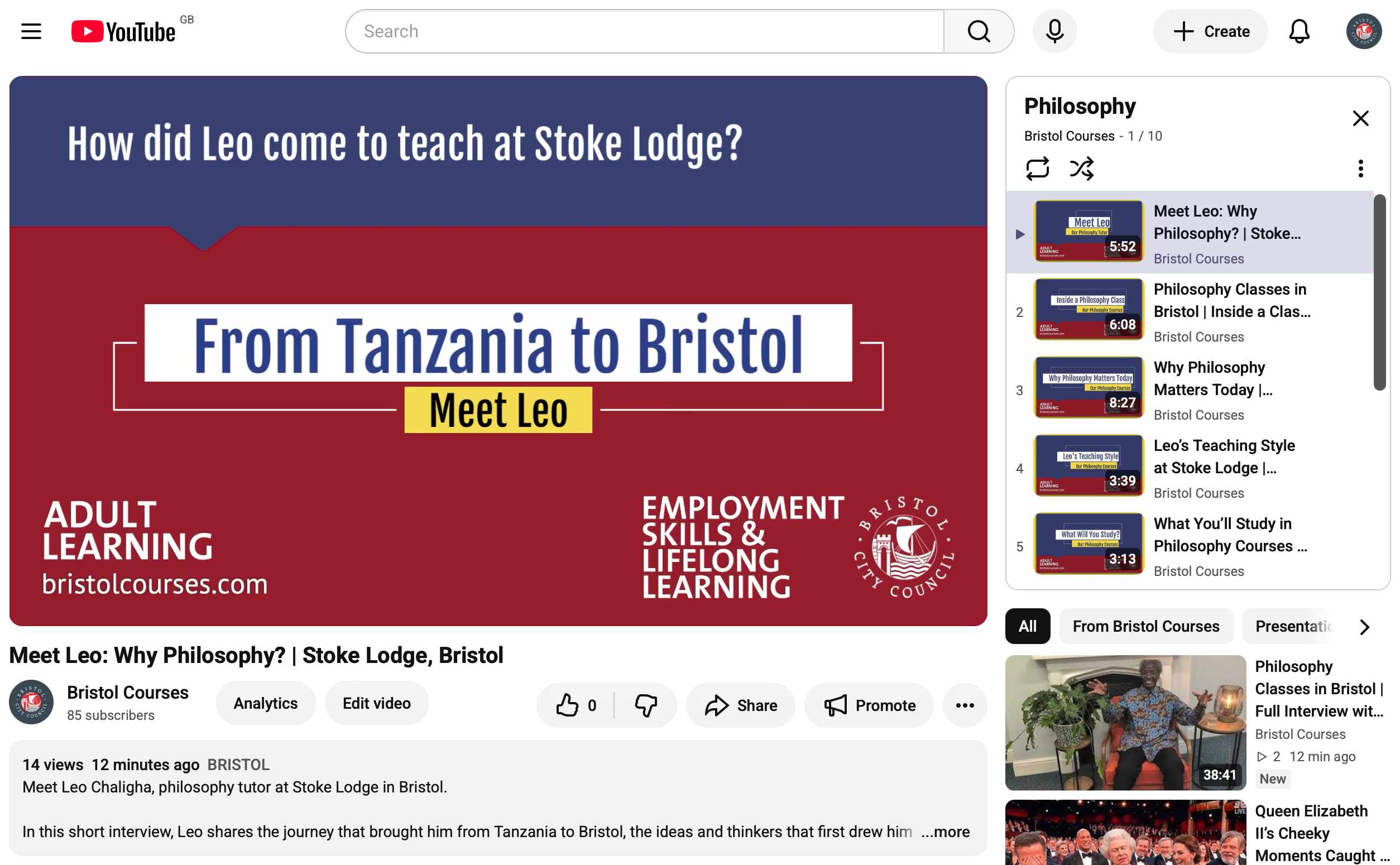
Starting With Search Intent
The standalone videos were editorially strong, with titles such as:
- Meet Leo
- Why Philosophy Matters Today
- Leo’s Teaching Style
- What You Will Study
- Philosophy in Practice
- How Philosophy Changes People
- Know Thyself
These worked well as on-screen titles. However, YouTube titles also needed to help somebody who had never heard of Leo or Stoke Lodge understand immediately what the video was about. For course-discovery content, we therefore introduced more explicit phrases such as:
Philosophy Classes in Bristol
Philosophy Courses at Stoke Lodge
Adult Philosophy Classes
Philosophy for Beginners
This allowed the editorial title and the search purpose to work together. For example:
On-screen title: Why Philosophy Matters Today
YouTube title: Why Philosophy Matters Today | Philosophy Classes in Bristol
The video retained its distinctive identity while gaining the location and course context needed by a prospective learner.
Creating a Consistent YouTube Series
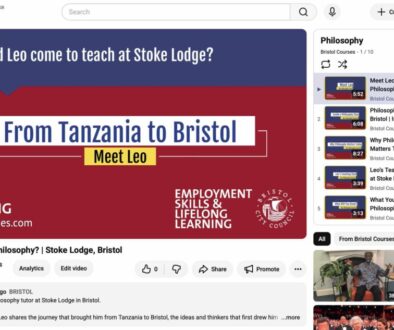
The videos were treated as a connected collection rather than individual uploads. The series was organised around Philosophy at Stoke Lodge. This created a consistent home for the standalone videos and the full interview. Each video then answered a different prospective learner’s question.
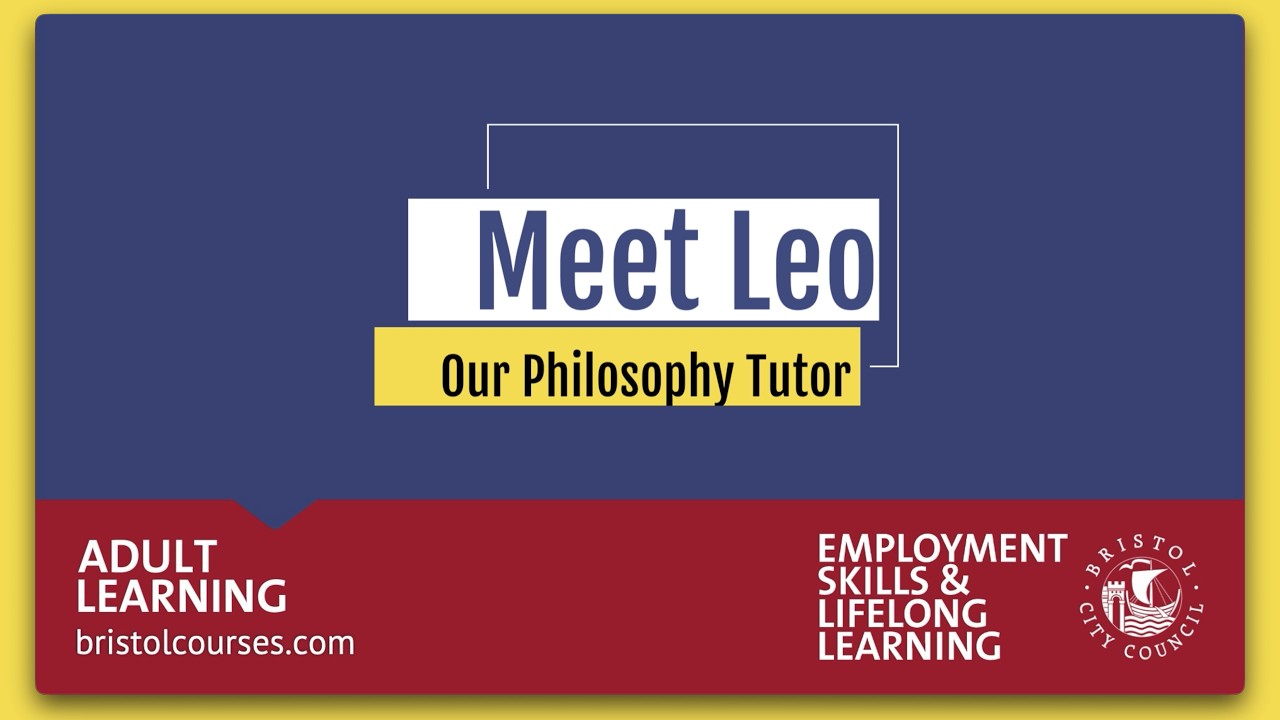
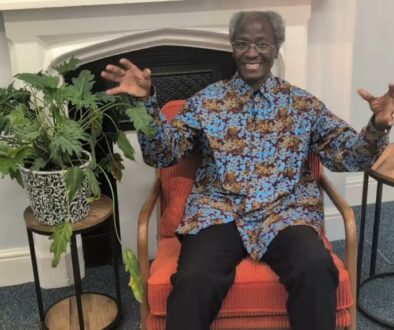
Meet Leo
A personal introduction covering:
- Leo’s journey from Tanzania to Bristol;
- what first attracted him to philosophy;
- his decision to choose philosophy over science.
This film gives viewers the opportunity to meet the person behind the course before deciding whether they would like to learn with him.
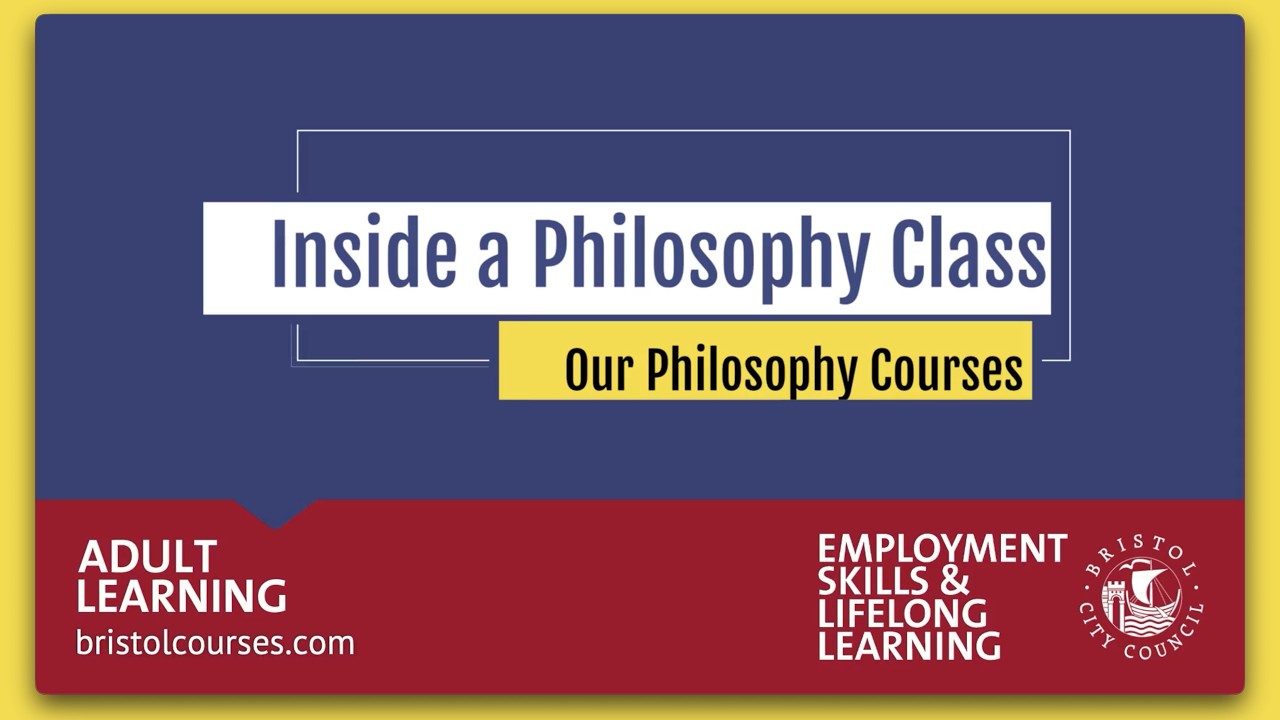
Inside a Philosophy Class
This video addresses practical questions such as:
- what happens during a class;
- whether beginners can join;
- how discussion works;
- how philosophical ideas are made accessible.
For a prospective learner, this may be more useful than a conventional course description because it gives a clearer sense of the actual learning experience.
Why Philosophy Matters Today
This video extends beyond course information into subjects including:
- critical thinking;
- artificial intelligence;
- ethics;
- democracy;
- environmental questions;
- everyday decision-making.
It provides broader discovery potential while still leading interested viewers back towards the Stoke Lodge course.
Leo’s Teaching Style
A more personal course-choice video. It explains:
- the Socratic approach;
- collaborative discussion;
- how quieter learners are encouraged to participate.
This addresses an important consideration that is difficult to communicate through a written course listing alone.
What You Will Study
A content-focused video introducing:
- Socrates;
- ethics;
- political philosophy;
- existentialism;
- social justice;
- epistemology;
- critical realism.
This gives prospective learners an immediate overview of the breadth of the programme.
Philosophy in Practice
A subject-led film with wider appeal. Leo’s village-pasture example connects:
individual self-interest → shared resources → climate change → the common good
It demonstrates what philosophical thinking can look like in practice.
How Philosophy Changes People
This video focuses on the benefits of study rather than course content. Themes include:
- critical thinking;
- challenging assumptions;
- seeing the world differently;
- curiosity;
- making time for intellectual exploration.
The Teacher as Learner
A reflective film showing that philosophical discussion is not simply one-way instruction.
Leo describes a learner challenging his own interpretation of Protagoras and how the experience changed the way he approached the subject.
Know Thyself
The concluding standalone video brings together:
- Socrates;
- self-knowledge;
- the examined life;
- Leo’s own definition of philosophy.
This provides a natural conclusion to the series.
Writing Video Descriptions for People, Not Just Search Engines
Each video received a purpose-written YouTube description. Rather than repeating the same generic paragraph, descriptions were written around the specific subject of each film. The structure typically included:
- An opening question or proposition
- A clear explanation of what the viewer will learn
- The subjects covered in the video
- Context about Leo and Stoke Lodge
- An invitation to explore the philosophy courses
- A link to relevant course information
- A link or reference to the wider video series
For example, a viewer arriving at Inside a Philosophy Class immediately encounters information about what the course experience is like. Someone arriving at Why Philosophy Matters Today instead encounters critical thinking, AI, ethics and contemporary life. The metadata therefore reflects the actual content of the video rather than treating every upload as interchangeable.
Connecting Videos to Course Discovery
The videos were created as promotional content for Bristol Adult Learning’s philosophy provision. For that reason, YouTube descriptions did not end with the video itself. They were designed to lead interested viewers towards:
- the relevant philosophy course information;
- Stoke Lodge;
- related videos;
- the complete philosophy series.
This creates a simple journey:
Search or recommendation
↓
|Watch useful philosophy content
↓
Learn about Leo and the course
↓
Visit course information
↓
Consider enrolling
The video becomes part of the course-discovery process rather than an isolated media asset.
Making Long Videos Easier to Navigate
The finished full interview runs for 38 minutes 41 seconds. A viewer may want to watch the complete programme, but others may only be interested in one part. The full interview was therefore structured around clear overarching topics such as:
- Meet Leo
- Inside a Philosophy Class
- Why Philosophy Matters Today
- Leo’s Teaching Style
- What You Will Study
- Philosophy in Practice
- How Philosophy Changes People
- The Teacher as Learner
- Final Reflections: Know Thyself
These sections could then be reflected in YouTube chapter navigation. This allows somebody to move directly to the topic most relevant to them without losing the option to watch the full conversation. The accepted project scope had specifically anticipated chapter breakdowns as part of the YouTube preparation.
Using Question Cards and Chapters Together
The edited interview already contained:
- topic cards;
- question cards;
- individual section headings.
YouTube chapters added another navigation layer. The two serve different purposes.
Question cards within the video help viewers understand what is happening while watching.
YouTube chapters help viewers navigate before or during viewing.
This is particularly useful for longer educational, interview and webinar content.
Captions and Accessibility
Captions were another important part of the publishing process. The original project proposal included closed captions within the YouTube preparation, as well as on-screen captions for the short-form social videos.
For the long-form and standalone films, captions were reviewed alongside the edited footage. This was particularly important because Leo discusses terminology and names that automatic transcription can easily misinterpret, including:
- Socrates;
- Frantz Fanon;
- Julius Nyerere;
- Protagoras;
- epistemology;
- existentialism;
- critical realism.
Captions therefore supported both accessibility and accuracy.
Creating Titles That Serve Different Purposes
Not every video needed to be optimised in exactly the same way. Some films were primarily course-discovery videos.
For example:
Philosophy Classes in Bristol | Inside a Class at Stoke Lodge
Others had stronger potential to attract a wider philosophy audience:
Philosophy in Practice | Climate Change & the Common Good
or:
Know Thyself | Philosophy Classes in Bristol
This allowed each video’s strongest hook to determine the title, while still maintaining a connection with Bristol, Stoke Lodge and adult philosophy courses where appropriate.
Local Search Context
Because the philosophy courses are delivered at Stoke Lodge in Bristol, location mattered. The publishing structure therefore incorporated relevant local context through:
- titles;
- descriptions;
- course links;
- recording location;
- references to Stoke Lodge;
- references to Bristol Adult Learning.
The purpose was not simply to attract the largest possible audience. It was to attract relevant viewers, including people who may genuinely be considering studying philosophy locally.
Building a Video Funnel
One of the most useful aspects of producing content at several lengths is that each format can lead to another. The complete content structure became:
Vertical social clips
Short, hook-led discovery content.
↓
Standalone topic videos
More context around a particular idea or question.
↓
Full interview
The complete conversation for viewers who want depth.
↓
Course information
The action point for somebody interested in joining.
This is considerably more useful than treating every video as a separate promotional post.

The Role of the 14 Social Shorts
The vertical videos created an additional route into the wider collection.
Topics included:
- “When I come home from philosophy, I’m glowing”
- “I gave up a science degree to study philosophy”
- “Do you need prior knowledge to study philosophy?”
- “Why philosophy matters in the age of AI”
- “Challenge the idea, not the person”
- “Can we do it — or should we do it?”
- “Life is full of layers”
- “Philosophy transforms you”
- “Curious about philosophy? Give it a try”
- “The one philosophical idea everyone should encounter”
- “What is philosophy?”
- The Village Pasture
- The Common Good
- “Philosophy doesn’t give you ready-made answers”
These were designed to work independently on social media while also introducing ideas explored more fully in the longer videos.

Thumbnails and Visual Consistency
A consistent visual treatment helps viewers recognise related videos.
Rather than trying to place every detail on a thumbnail, the recommended approach was to use short, strong hooks such as:
- WHY PHILOSOPHY?
- INSIDE A PHILOSOPHY CLASS
- THINKING DIFFERENTLY
- STILL LEARNING
- KNOW THYSELF
The title could then provide the search and location information that the thumbnail did not need to carry.
This division of labour keeps the visual presentation cleaner:
- Thumbnail = curiosity
- Title = context and search relevance
- The Full Interview as the Central Asset
The 38:41 full interview performs a different role from the standalone videos. It acts as the definitive version of the conversation.
The shorter content can introduce viewers to individual themes, while the full interview provides:
- depth;
- context;
- Leo’s personality;
- the complete philosophy-course story.
This makes it an appropriate destination for viewers who discover Leo through one of the standalone films or social clips and want to learn more.
Purposeful Collection
The YouTube work transformed a collection of finished video files into a structured content series. The project delivered:
- A clear series identity
- Philosophy at Stoke Lodge
- 9 purpose-led standalone videos: Each targeting a different subject, question or stage of course consideration.
- 1 navigable full interview: Structured around clear themes and questions.
- 14 short-form entry points: Designed to introduce individual ideas through social media and vertical video.
- Search-focused metadata: Including titles, descriptions, course terminology and Bristol/Stoke Lodge context.
- Accessibility support: Through reviewed captions and clear on-screen information.
- Links back to relevant course content: Creating a path from watching to further exploration.
The result was not simply a YouTube channel containing videos. It was a connected digital content journey built around one expert interview.
Why YouTube Optimisation Matters
Uploading a video and optimising a video are not the same thing. A finished video still needs decisions about:
- what it should be called;
- who it is for;
- what someone might search for;
- how the description should introduce it;
- whether it needs chapters;
- where it sits within a playlist;
- how viewers move to related content;
- what action they should take next;
- how the video connects to the organisation’s website.
For organisations creating educational, professional or expert-led content, these decisions can substantially improve the usefulness of the video library.
The objective is not simply to accumulate views. It is to help the right audience find the right content and know where to go next.
Have a Video Library That Needs Organising?
You may already have high-quality videos on YouTube that are difficult to discover or disconnected from your wider website and marketing activity.
Xelium can help with:
- YouTube content strategy;
- titles and descriptions;
- search-focused content positioning;
- playlist planning;
- video chapters;
- captions;
- thumbnail direction;
- course and service links;
- structuring long-form and short-form content;
- connecting YouTube with website content and user journeys.
Whether we have edited the videos ourselves or you already have an existing content library, we can help turn individual uploads into a more coherent digital resource. Talk to Xelium about YouTube content optimisation.